The Org Chart Is a Coping Mechanism
Org charts exist to manage bandwidth, not work. AI is removing the bandwidth constraint, and that changes everything about why your structure looks the way it does.

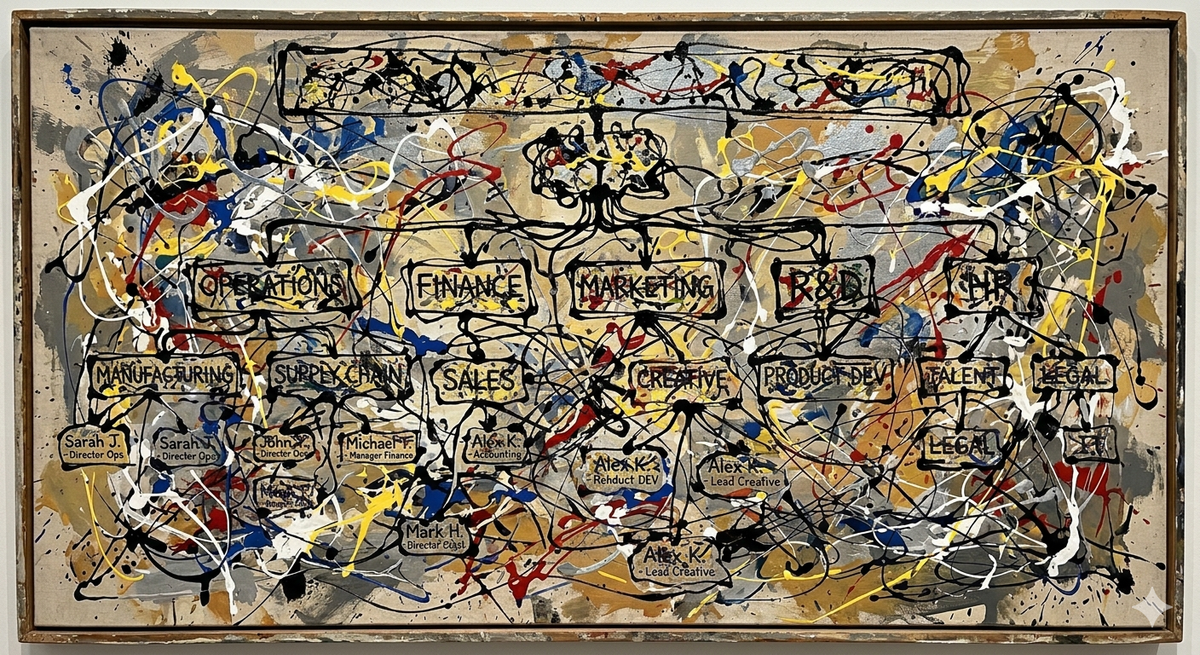
And obviously AI is about to expose it.
I once sat through a reorg in my consulting days where a VP spent forty-five minutes rearranging boxes on a slide. He moved a data team from under Finance to under Marketing, then moved them back, then added a dotted line to a third group that didn't exist yet. When someone asked what problem this solved, he said "alignment."
Nobody in the room could explain what that meant. But everyone nodded. I've sat in that meeting a dozen times since (different company, different slide template, same energy). The boxes change. The titles change. The underlying problem doesn't, because nobody ever names it. The org chart is ultimately a coping mechanism for the fact that humans have limited bandwidth for processing information and making decisions. We draw boxes and lines because we can't hold the full picture in our heads, so we parcel it out. You handle this. I'll handle that. We'll meet on Tuesdays to sync.
That worked, for a long time, because there wasn't an alternative.
Org charts solve information routing and decision making
Strip away the job titles and reporting lines, and an org chart is doing a small number of jobs that have nothing to do with expertise or value. It routes information so that the right people hear what they need. It allocates decision rights so that not everyone is deciding everything simultaneously. And it caps cognitive load, because a team of eight can hold shared context but a department of eighty cannot.
In technical terms the org chart is a compression algorithm for human limitations (the data structures coursework finally paying off, with apologies to Professor Christozov for not paying attention).
And like any compression algorithm, it loses data.
The things that fall between the boxes, the context that doesn't cross team boundaries, the decision that nobody realises needs to be made because it sits in the gap between two groups. If you've ever done process improvement work, you know the problems are almost never inside a team. They're in the handoffs, in the in-betweens.
With AI we are dramatically expanding what a single person can process
Now imagine you give every person in your company a tool that can instantly summarise what happened in any team's last sprint. That can pull together context from six Slack channels, three Jira boards, and a Confluence space nobody reads. That can tell a junior engineer what the sales team is hearing from customers this week, without anyone scheduling a meeting or writing an update.
If the org chart exists because humans can't process everything at once, and AI dramatically expands what a single person can process, then a lot of those boxes start looking like artifacts of a constraint that no longer applies. Not the people. The structural reasons for their positions.
The clearest example is the role built around being the gate. The person who controls access to data, to stakeholders, to the meeting where the decision actually gets made. Their value depended on information being scarce and difficult to assemble. When information becomes ambient and accessible, gatekeeping stops working as a strategy. It just looks like delay.
Translation layers between teams have a similar problem. So do the coordination roles whose week is mostly spent turning one team's status update into another team's input.
The work isn't going away, but the question worth asking is whether it still needs a person sitting in the middle, or whether what's left after AI does the synthesis is too thin to support the role.
What the synthesis loses
I've noticed something in myself that complicates this, and I think it's worth sitting with rather than waving past. These roles were not just routing explicit information. A lot of their value lived in the implicit. The worried tone in a comment. The fact that someone didn't push back in a meeting when they usually would. The pattern across forty tickets that only becomes visible if you've been staring at them for months.
I used to pick up on things by being in the room, by scrolling through ticket comments at 9am, by feeling the energy of a standup. Now I get a summary. It's faster. I'm not sure it's better. AI synthesis gives you the high-level, which is genuinely useful. But high-level is compressed. And we already know what compression does: texture goes first.
Now let's talk real life
Org charts aren't going away. You still need accountability, mentorship, someone to fight for headcount in budget season, someone to tell a person their work isn't good enough in a way that doesn't destroy them. But a lot of organisational structure was never about those things. It was about bandwidth. And once the bandwidth constraint loosens, the structure built around it starts feeling arbitrary. Most companies don't have a good answer. The real one is usually "this is how it was when I got here," or "we reorged around a problem three years ago and never revisited it."
Real life is messy. These structures aren't just boxes on a slide. They're people's jobs, their career progression, their sense of where they fit and what they're worth. When that starts shifting, it isn't an abstract redesign exercise. There are real people in those roles trying to figure out if they're being made redundant, if their manager is, what this means for them next year. That weight doesn't go away because someone in the C-suite calls it a rewiring.
If you're the one with the AI mandate, the most useful first move isn't a reorg. It's a quieter question, asked of your own org chart: which boxes are there because of bandwidth, and what happens to those boxes when bandwidth stops being the constraint? Not who's underperforming. That's a different conversation.
You don't have to answer it in a slide. You probably shouldn't. But you should have an answer before someone above you decides to.
A meaningful chunk of management work is information synthesis and routing. If AI handles that, what's left is mentorship, strategy, hiring, unblocking. That's real work, and it's the work that actually requires a human. The worse version of this transition is the quiet one. Leadership realises the management layer is structurally thinner than it looks, says nothing for two quarters, then announces a reorg with a slide deck. The better version is the one where someone says, out loud, that the structure was built for a world with different constraints, and those constraints are changing, and the next version is something we should figure out together. People might not want to change, but people can handle change.
The org chart will still be there next year, but the reasons it looks the way it does are shifting underneath it, and most companies haven't caught up. The ones that do won't be the ones with the most ambitious AI rollout. They'll be the ones who can answer, plainly, why each layer exists, and who are willing to act on the answer when it isn't flattering.